


Door 10 – nPM2100 Power Management IC
nPM2100
Power Management IC with ultra-efficient boost regulator for primary-cell batteries
The nPM2100 is a dedicated Power Management IC (PMIC) from Nordic Semiconductor designed for products powered by primary (non‑rechargeable) batteries, with a strong focus on ultra‑low power and long battery life. It is optimized to provide highly efficient power regulation for low‑power MCUs and SoCs such as Nordic’s nRF52, nRF53, and nRF54 Series, but can also be used with non‑Nordic hosts.
At its core, nPM2100 integrates
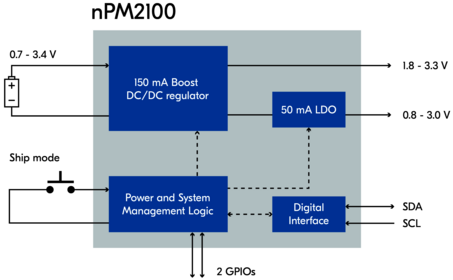
- Ultra‑efficient boost regulator delivering up to 150 mA, with 1.8–3.3 V output from 0.7–3.4 V input.[Key features DS] It supports automatic pass‑through when the battery voltage exceeds the set output voltage, improving efficiency at higher input voltages.
- LDO / load‑switch rail supplied from the boost output, providing 0.8–3.0 V up to 50 mA for an additional regulated supply.
The device supports battery voltages up to 3.4 V and can run from sources like one or two AA/AAA cells in series, a single 3 V LiMnO₂ (e.g., CR2032), and other primary chemistries within its input range. It can start from about 0.8 V and operate down to 0.7 V, enabling deep utilization of battery capacity.
For lifetime extension, nPM2100 offers multiple ultra‑low‑power modes
- Ship mode with down to 35 nA current, allowing products to be shipped with batteries installed without significant drain; wakeup can be triggered in several ways, including a “break‑to‑wake” event when an electrical connection is broken.
- Hibernate mode with a wakeup timer and typical current around 175 nA, for designs that spend most of their time in deep sleep; this can extend sleep‑dominated product lifetimes by up to about three times compared to keeping the MCU in its own deep‑sleep state.
A key differentiator is fuel gauging for primary cells. nPM2100 measures temperature and battery voltage and, combined with a fuel‑gauge algorithm running on the host using nRF Connect SDK, it provides more accurate state‑of‑charge estimates than simple voltage‑based methods. This helps avoid premature battery replacement and unexpected shutdowns by using more of the actual cell capacity.
The PMIC includes system‑oriented features such as
- Two GPIO pins that can control time‑critical functions (for example power rails) without needing serial transactions.
- System monitor functions like watchdog timer, boot monitor, power‑good signaling, and a multifunction single‑button interface for power on/off, hard reset, and ship‑mode control, all accessible via an I²C‑compatible two‑wire interface (TWI).
nPM2100 comes in very compact packages - a 1.9 × 1.9 mm WLCSP and a 4 × 4 mm QFN16 -requiring only a small inductor and a few capacitors, enabling PCB solutions from about 4 × 4 mm.
Typical applications include computer peripherals and HID devices, remote controls, smart‑home sensors, Bluetooth LE asset trackers, fitness accessories, and personal medical devices where long lifetime on primary cells and accurate fuel gauging are critical.
Key features
- Ultra-efficient boost regulator, delivering up to 150 mA
- 50 mA LDO/Load switch supplied by the boost regulator
- 35 nA Ship Mode with multiple wakeup options
- 175 nA Hibernate mode with wakeup timer
- Fuel gauge for primary cell batteries
Getting started
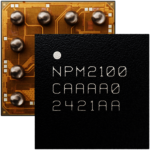
NPM2100-CAAA-R
1.9 x 1.9 mm
WLCSP
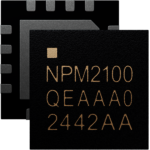
NPM2100-QEAA-R
4 x 4 mm
QFN16
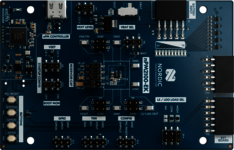
nPM2100
Evaluation Kit
Participate and Win!
How does the competition work?
You can win a Chipolo LOOP or CARD and a Nordic DevKit of your choice on behalf of your company.
To enter, select which Chipolo finder you would like to receive, as well as which Nordic boards you would like to win (you can select multiple options, and the lottery will decide which one you may win).
Fill out the form now and, with a little luck, you will receive the combination of your wishes:
Registration Form
Unfortunately, the competition has now ended. Discover the products in our shop and get in touch with our Nordic experts.
Learn more about the prizes

Nordic Semiconductor is a global leader of ultra-low-power wireless technologies and a long term partner of Rutronik and is offering you the opportunity to win one of their development hardware. Participate in our advent calendar and explore the world of Power Management, Short Range, Wi-Fi and Cellular.
nRF54L15-DK
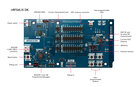
The nRF54L15 DK (Development Kit) features the nRF54L15 wireless SoC (System-on-Chip) and can emulate the nRF54L10, and nRF54L05 wireless SoCs. The affordable DK makes all features available to the developer on a single board.
nRF54LM20-DK
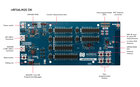
The nRF54LM20-DK is a development kit for the nRF54LM20A wireless SoC supporting Bluetooth LE, Matter, Aliro, Thread, Zigbee, and 2.4 GHz proprietary protocols (up to 4 Mbps).
nPM1304-EK
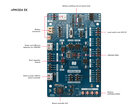
The nPM1304 Evaluation Kit for the nPM1304, a highly sophisticated Power Management IC (PMIC) with battery charging and unique system management features such as accurate fuel gauge, watchdog & boot timer, ship & hibernate mode and much more.
nPM1300-EK
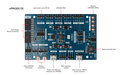
The nPM1300 Evaluation Kit (EK) is a hardware platform for evaluating and configuring the nPM1300 Power Management IC (PMIC) through code-free integration with the nPM PowerUP desktop app.
nPM2100-EK
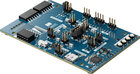
The nPM2100 Evaluation Kit (EK) is a hardware platform for evaluating and configuring the nPM2100 Power Management IC (PMIC) designed for non-rechargeable batteries, with seamless code-free configuration through the nPM PowerUP desktop app.
Power Profiler Kit 2
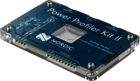
The Power Profiler Kit II (PPK2) is a standalone unit, which can measure and optionally supply currents all the way from sub-uA and as high as 1A on all Nordic DKs, in addition to external hardware.
nRF7002-DK
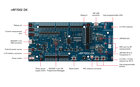
The nRF7002 DK is the development kit for the nRF7002, and nRF7001 Wi-Fi 6 Companion ICs. It contains everything needed to get started developing on a single board. The DK features an nRF5340 multiprotocol System-on-Chip (SoC) as a host processor for the nRF7002.
nRF9151-DK
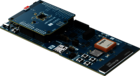
The nRF9151 DK is an affordable, pre-certified single board development kit for evaluation and development on the nRF9151 System-in-Package (SiP) for LTE-M, NB-IoT, GNSS and DECT NR+. It has a dedicated LTE-M, NB-IoT and DECT NR+ antenna that supports a wide range of bands to operate globally.
Thingy:91 X
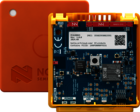
The Nordic Thingy:91 X is a battery-operated prototyping platform for cellular IoT based on the nRF9151 System-in-Package (SiP) supporting LTE-M, NB-IoT, GNSS and NR+, and certified for global operation. It is the ideal platform for rapidly developing a prototype for any cellular IoT concept, and is especially suited for asset-tracking applications. Nordic Thingy:91 X enables location tracking using cellular (MCELL and SCELL), Wi-Fi, or GNSS, in combination with nRF Cloud Location Services.

On top of this you have the chance to win a finder from our customer Chipolo. This product is a lightweight, water-resistant item finder designed to help you find your missing valuable items.

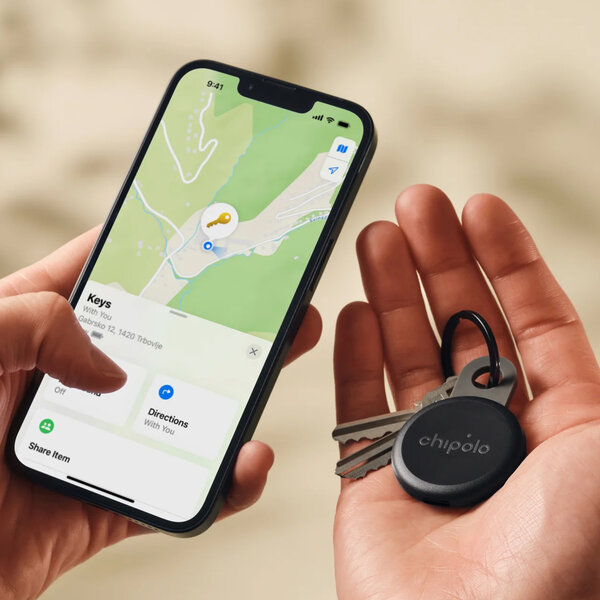

Chipolo LOOP
Rechargeable tracker with flexible silicone strap for easy attachment. Enjoy the freedom of universal compatibility with Apple “Find My” or Google “Find My Device.”
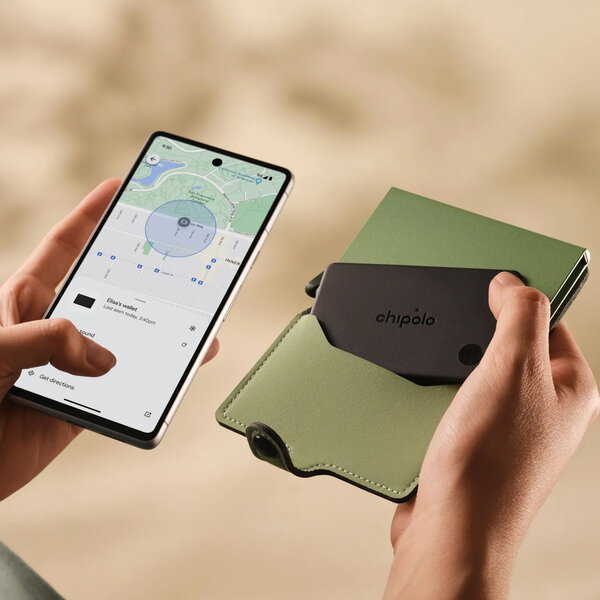
Chipolo CARD
Thin, rechargeable tracker that fits perfectly in your wallet. Discreetly slim yet impressively loud, CARD helps you keep track of your most important flat items. Universally compatible with Apple's “Find My” or Google's “Find My Device”.


If you haven't already, be sure to check out our social media channels!





Keep up to date with the RUTRONIK newsletter.
