























About Toshiba
Excellence in power defines Toshiba Electronics Europe GmbH (Toshiba). The company delivers advanced semiconductor solutions and components designed to meet the highest standards of technology, quality, and sustainability. Its products enable engineers to optimise performance, reliability, and energy efficiency across critical applications, supporting the transition to an all-electric society.
Toshiba focuses on key sectors such as e-mobility, energy and infrastructure, factory automation, and AI/data centers, continuously expanding its product range and manufacturing capacity to meet growing demand. Toshibas' broad portfolio includes power semiconductors and other discrete devices ranging from diodes to logic ICs, power MOSFETs, optical semiconductors as well as motor control devices and application specific standard products (ASSPs) amongst others.
The company focusses on power systems design as well as on motor control solutions and customers can benefit from more than 40 years of core competence optimizing solutions for power density and efficiency. In addition, Toshiba provides also lithium titanium oxide (LTO) batteries (SCiBTM) for heavy-duty applications and HDD solutions.
Headquartered in Düsseldorf, Germany, Toshiba Electronics Europe operates branch offices in France, Italy, Spain, Sweden, and the United Kingdom, offering marketing, sales, and logistics services across Europe.
Featured Product Groups
Automotive & Industrial MOSFETs
Toshiba’s MOSFET lineup spans automotive 12–48 V systems and industrial power stages, combining advanced trench, super‑junction and SiC technologies with low‑RDS(on), low‑noise performance and efficient packaging such as S‑TOGL™/L‑TOGL™, DFN8×8, TOLL and TO‑247‑4L(X). Automotive devices cut conduction loss and shrink ECUs, while industrial U‑MOS, DTMOS and 3rd‑gen SiC MOSFETs deliver high efficiency and fast switching for SMPS, UPS, PV inverters, data‑centre and factory‑automation equipment.
Why Toshiba: Packaging leadership, broad Si/SiC portfolios, automotive‑grade qualification and proven device stability help engineers meet tough efficiency, thermal and EMI targets across automotive and industrial designs.
Automotive & Industrial Motor Control ICs/MCUs
Toshiba provides a comprehensive motor‑control portfolio for automotive and industrial applications, covering brushed, stepper and BLDC drivers, gate drivers and integrated SmartMCD™ solutions that merge MCU and driver stages for efficient, sensorless FOC. These devices enable compact, high‑efficiency motor systems across pumps, fans, auxiliaries, consumer equipment and industrial machinery, while advanced technologies help reduce BOM, board size, tuning effort and power consumption. Toshiba’s lineup also includes general‑purpose and motor‑control MCUs backed by decades of microcontroller expertise.
Why Toshiba: More than 40 years of motor‑control expertise, a broad portfolio spanning drivers to MCUs, and European application support through Rutronik. For Automotive high integration and proven driver technology enable fast platform reuse across pumps, fans, and other auxiliaries - all with automotive‑grade reliability.
SiC Modules
Toshiba’s SiC MOSFET modules combine low‑loss chip technology with robust module design to deliver high efficiency, fast switching, and stable thermal performance. Their low stray inductance and high channel‑temperature capability support compact, reliable architectures for traction drives, industrial inverters, and renewable‑energy systems
Why Toshiba: High‑reliability SiC with embedded SBD, proven silver‑sintered assembly, and module options up to 3300 V / 800 A enable lower switching losses and seamless upgrades from Si‑IGBT footprints. The result: higher power density and long‑term electrical stability in demanding environments.
Photocouplers & Isolators / Solid-State Relays
Toshiba’s isolation portfolio spans gate‑driver photocouplers, high‑speed logic photocouplers, digital isolators and photorelays, delivering reinforced insulation, strong CMTI and compact SOxL package options for robust inverter, FA and PLC signal chains. Gate‑driver photocouplers-including versions with active Miller clamp-ensure reliable SiC/IGBT switching control, while logic photocouplers support EMC‑resilient communication up to 50 Mbps with isolation ratings up to 5 kVrms.
Why Toshiba: A broad, proven lineup—from ±70 kV/µs‑class drivers with clamp functions to space‑efficient logic couplers - ensures high noise immunity, long‑term safety credentials and easy optimisation of drive current, CMTI, creepage and board area within one unified ecosystem.
New Product Information
650V 3rd gen SiC MOSFETs in TOLL - compact, efficient, fast
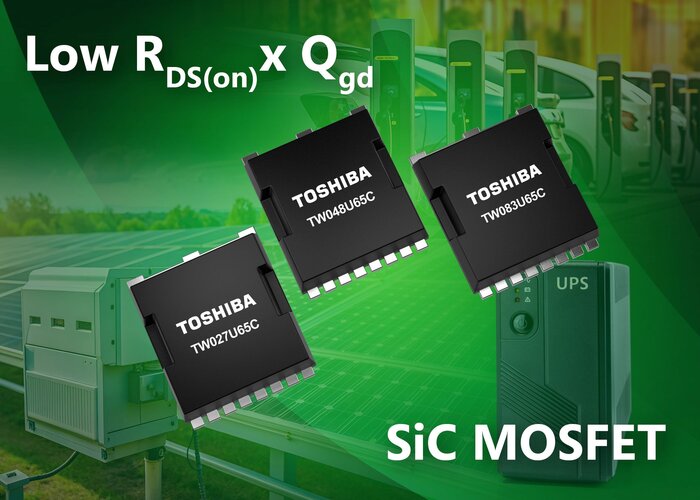
Toshiba’s TW027U65C, TW048U65C and TW083U65C bring 3rd‑generation SiC performance to a surface‑mount TOLL package that cuts device volume by >80% vs. TO‑247. The Kelvin‑source layout enables low‑inductance, high‑speed switching — the TW048U65C achieves ~55% lower Eon and ~25% lower Eoff than a non‑Kelvin TO‑247 equivalent.
Stable RDS(on) over temperature, low RDS(on) ×Qgd FOM and a wide −10…25 V VGSS range simplify gate‑drive design across SMPS, UPS, EV chargers and PV inverters.
Why Toshiba: Strong SiC roadmap, advanced packaging and reliable parametrics that boost efficiency and power density.
100 V MOSFET with 2.7 mΩ RDS(on) and 52 nC Qg
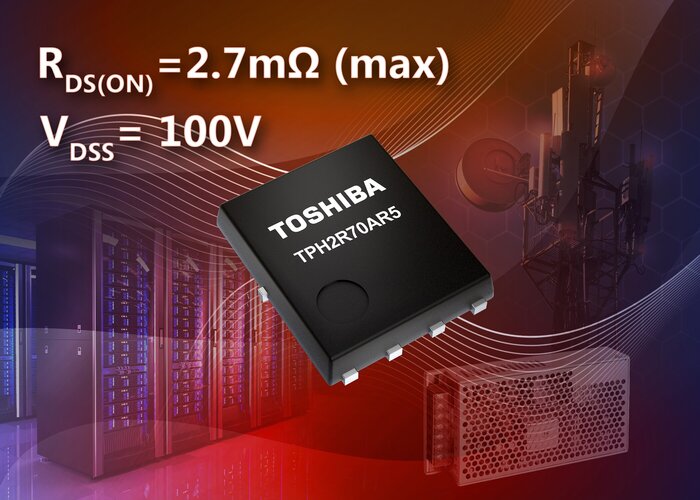
Toshiba’s TPH2R70AR5 delivers a 42% FoM improvement (RDS(on)×Qg) over U‑MOSX‑H devices, achieving just 2.7 mΩ max RDS(on) and 52 nC Qg. Lifetime‑controlled body diode technology cuts Qrr to 55 nC and suppresses voltage spikes, boosting efficiency in high‑performance DC‑DC converters for data centre, telecom and industrial SMPS designs.
With a 190 A ID rating, 175 °C channel temperature capability and a 5.15 mm × 6.1 mm SOP Advance (N) footprint, the device supports high power density and easy mounting compatibility.
Why Toshiba: Latest‑gen U‑MOS11‑H process, superior switching and diode performance, and robust design tools (G0/G2 SPICE models) that simplify precision power‑stage development.
Compact automotive BLDC gate driver IC with single shunt support
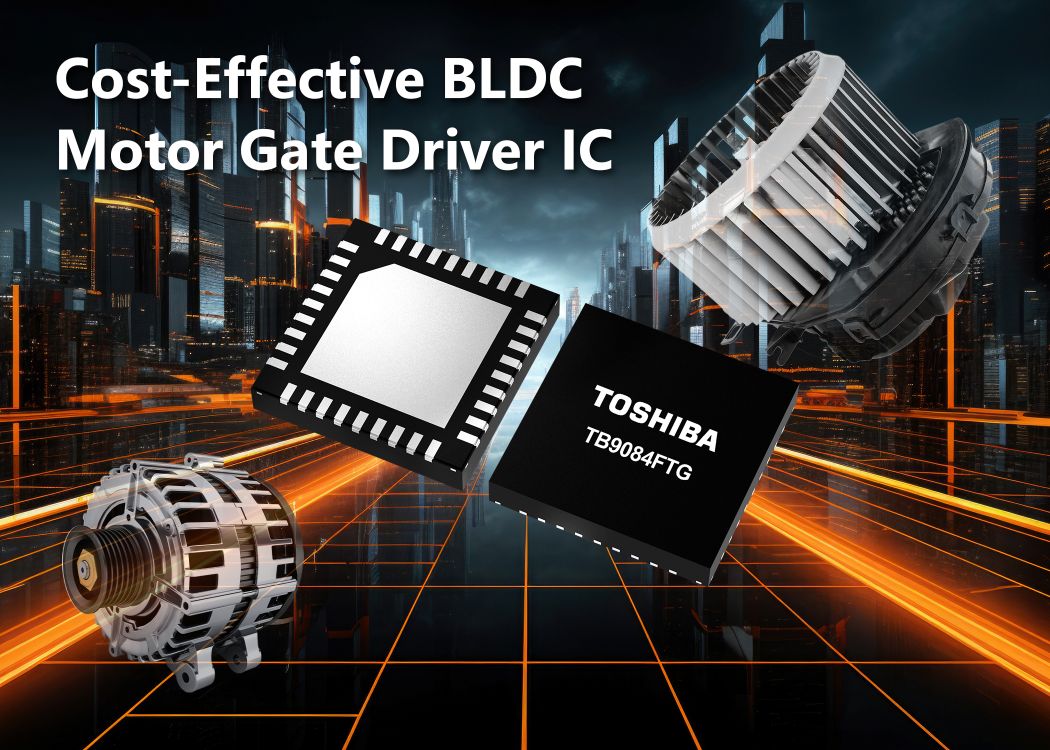
Toshiba’s TB9084FTG is a cost‑effective gate‑driver IC for three‑phase BLDC motors used in automotive body systems, pumps, fans and motor‑generator units. It integrates a charge pump, current‑sense amplifier, oscillator, SPI and comprehensive fault‑detection circuits — all in a compact 6×6 mm VQFN36 package enabled by an optimised circuit architecture.
The device supports single‑shunt current sensing, offers robust AEC‑Q100 Grade 0 reliability (‑40 °C to +150 °C), and features a wettable‑flank package for easy solder‑joint inspection. Its strong functional integration simplifies miniaturisation and enhances system design flexibility.
Why Toshiba: Deep automotive expertise, proven gate‑driver architecture, Grade 0 quality and packaging innovations that boost reliability while shrinking system size.
Next gen stepper motor driver with Advanced Microstep Technology
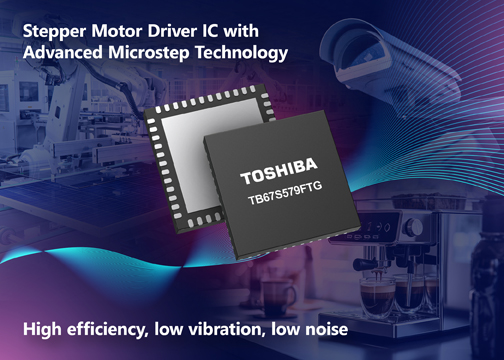
Toshiba’s TB67S579FTG brings a new generation of stepper‑motor control to office, commercial and industrial equipment. Its Advanced Microstep Technology combines AGC2, Automatic Wave Generation (AWGS) and Continuous Microstepping for higher efficiency, smoother motion, and significantly reduced vibration and noise — even at low speeds.
The driver integrates advanced functions such as ACDS current detection (no external sense resistor), a built‑in charge pump, serial configuration, and ADMD for up to 30% higher rotation speed. With 40 V / 2 A capability, low 0.6 Ω RDS(on) and a compact 7×7 mm VQFN48 package, it cuts board space and BOM while providing robust protection features including overcurrent, thermal shutdown, UVLO, open‑load and stall detection.
Why Toshiba: Best‑in‑class microstepping innovation, integrated efficiency‑boosting features, and space‑saving architecture that simplifies precise motion‑control designs.
SOP Advance(E) MOSFETs with lower RDS(on) & improved thermal performance
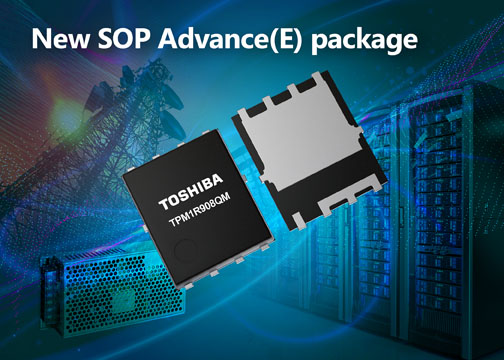
Toshiba’s new 80 V TPM1R908QM and 150 V TPM7R10CQ5 bring the next‑generation SOP Advance(E) package to high‑efficiency SMPS designs for industrial equipment, data centres and communication base stations. The package cuts package resistance by ~65% and thermal resistance by ~15%, enabling significantly lower loss and higher power‑stage efficiency.
Both devices deliver ~21% lower RDS(on) and ~15% lower Rth(ch‑c) compared to previous equivalents, with the 150 V TPM7R10CQ5 additionally featuring a high‑speed body diode for improved synchronous rectification. Rated up to 238 A / 1.9 mΩ (80 V) and 120 A / 7.1 mΩ (150 V), the MOSFETs operate up to 175 °C in a compact 4.9 × 6.1 mm footprint, reducing board space and supporting higher density designs.
Why Toshiba: Advanced packaging that delivers real efficiency gains, strong thermal behaviour and industry‑leading low‑loss MOSFET performance—supported by G0/G2 SPICE models for fast, accurate power‑stage design.
Featured Topics

Future‑driven power technologies.
Toshiba advances Power semiconductor technologies in lockstep with packaging, modelling and gate‑drive know‑how, underpinned by scaled 300 mm manufacturing in Kaga and AI‑driven process optimisation to accelerate learning cycles and reproducibility.
Why Toshiba: cross‑disciplinary R&D plus vertically aligned whitepapers, factories and packages that let engineers trade off loss, robustness and parasitics at system level, not just at die level.

Quality designed‑in and built‑in, not inspected‑in.
Toshiba’s semiconductor Quality Guidelines formalise DR/AT (Design Review/Approval Test), rigorous change control, and SPC‑driven process monitoring from wafer to assembly, backing it up by structured reliability evaluation and continuous improvement loops.
Why Toshiba: a transparent, codified QA system that de‑risks qualifications and helps engineers predict lifetime behaviour under real operating stresses.

Device‑level efficiency, enterprise‑level decarbonisation.
By cutting conduction and switching losses, Toshiba power devices lower system energy and thermal overheads; at the corporate level, Environmental Future Vision initiatives drive net‑zero targets across the value chain with TCFD‑aligned governance.
Why Toshiba: a tangible CO₂ reduction at both product and manufacturing scales for designs targeting stringent sustainability KPIs.